Lithium Battery Testing in Umargam
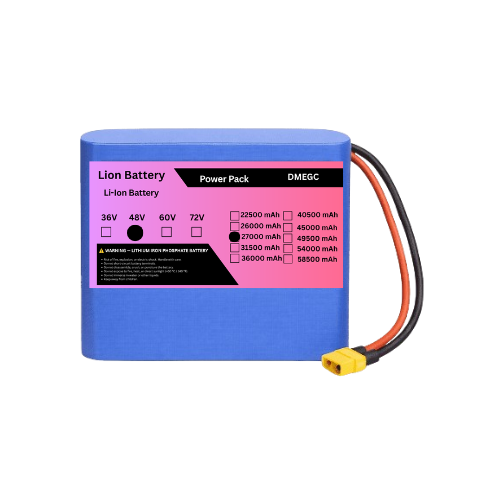
If you are looking for Lithium Battery Testing in Umargam, Lion Battery provides battery testing and diagnostic services for Li-ion, NMC and LiFePO₄/LFP battery packs used in EVs, e-bikes, scooters, solar systems, UPS, drones, industrial equipment and custom battery applications.
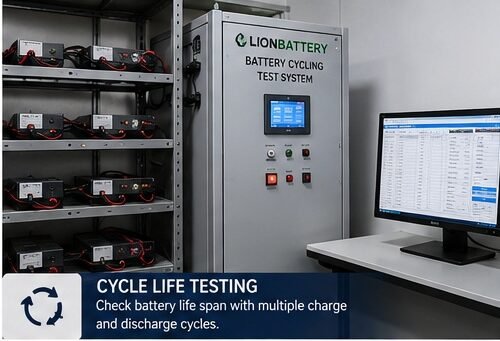
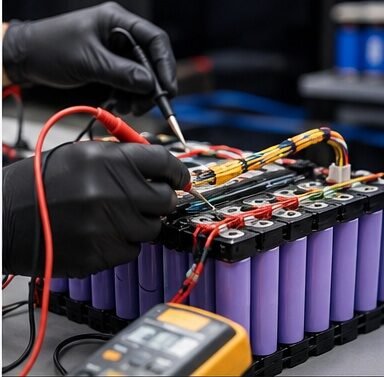
Lion Battery’s published manufacturing information includes capacity testing, internal-resistance testing, cell-voltage testing, charge/discharge testing, BMS testing and temperature monitoring.


6
Battery Testing Services in Umargam
1. Battery Voltage Testing
We can check:
- Overall battery pack voltage
- Individual cell/group voltage
- Charging voltage
- Discharge voltage
- Voltage imbalance
For multi-series packs, checking individual cell groups is important because the total pack voltage alone may not reveal an unhealthy cell group.
2. Battery Capacity Testing
Capacity testing determines how much usable energy a battery can actually deliver compared with its rated capacity.
The basic calculation is:
Capacity (Ah) = Discharge Current (A) × Discharge Time (hours)
For example, if a 20Ah battery delivers 18Ah during a controlled test, its measured capacity is approximately 90% of the rated capacity.
For accurate evaluation, testing should be performed using controlled current and appropriate voltage cut-off limits.
3. Internal Resistance Testing
Internal resistance testing can help identify:
- Weak cells
- High-resistance cells
- Cell imbalance
- Aging cells
- Poor connections
- Possible pack problems
Higher internal resistance can result in greater voltage drop and heat generation when the battery is under load.
4. Charge Testing
A battery can be evaluated during charging for:
- Charging voltage
- Charging current
- BMS cut-off
- Cell-group voltage behavior
- Cell balancing
- Temperature
- Charger compatibility
5. Discharge Testing
Controlled discharge testing can help determine:
- Actual capacity
- Voltage drop
- Discharge performance
- Cut-off behavior
- Temperature rise
- BMS protection
6. BMS Testing
The Battery Management System (BMS) can be checked for relevant protection and monitoring functions, such as:
- Overcharge protection
- Over-discharge protection
- Overcurrent protection
- Short-circuit protection
- Temperature protection
- Cell balancing
- Cell voltage monitoring
For smart battery systems, communication may also be evaluated where applicable.
Lithium Battery Cell Testing
For individual cells or cell batches, testing can include:
| Test | Purpose |
|---|---|
| OCV / Voltage | Check cell voltage |
| Internal Resistance | Identify resistance variation |
| Capacity | Measure actual Ah |
| Charge Test | Evaluate charging behavior |
| Discharge Test | Measure usable capacity |
| Temperature | Monitor heating |
| Visual Inspection | Check physical condition |
Cell testing and matching are also part of Lion Battery’s published battery manufacturing process.
EV Battery Testing in Umargam
EV battery packs require testing under conditions relevant to their vehicle application.
Testing can include:
- Pack voltage
- Cell-group voltage
- Capacity
- Internal resistance
- Charge performance
- Discharge performance
- BMS operation
- Temperature monitoring
- Wiring and connector inspection
This can be useful for electric scooters, e-bikes, electric motorcycles, three-wheelers and other EV battery packs.
Battery Testing for Solar & LFP Batteries
LiFePO₄ batteries used in:
- Solar systems
- ESS
- UPS
- Inverters
- Telecom backup
- Industrial backup
can also be evaluated for capacity, voltage, BMS operation, charging and discharge performance.
Drone & UAV Battery Testing
Drone batteries require particular attention to capacity, internal resistance and voltage sag, especially when high current is required.
Testing can help identify:
- Weak cells
- Capacity loss
- Increased internal resistance
- Cell imbalance
- Excessive voltage drop
- Battery degradation
This can be useful for agriculture drones, mapping drones, inspection drones and other UAV applications.
Lithium Battery Testing Process
A typical diagnostic workflow is:
1. Visual Inspection
↓
2. Identify Chemistry & Configuration
↓
3. Measure Pack Voltage
↓
4. Measure Individual Cell Groups
↓
5. Check Internal Resistance
↓
6. Controlled Charging
↓
7. Controlled Discharge
↓
8. Measure Capacity / Energy
↓
9. Check Temperature
↓
10. Check BMS
↓
11. Final Assessment
The exact tests depend on the battery type and application.
Battery Capacity vs Rated Capacity
A battery marked 48V 30Ah should not automatically be assumed to deliver exactly 30Ah under every test condition.
Measured capacity can vary because of:
- Discharge current
- Cut-off voltage
- Temperature
- Cell age
- Cell chemistry
- Cell condition
- BMS settings
- Test equipment
Therefore, capacity should be compared using the agreed test conditions.
Battery Testing Report
For commercial/OEM requirements, useful test information can include:
| Parameter | Result |
|---|---|
| Battery Chemistry | NMC / LFP |
| Configuration | e.g. 13S10P |
| Rated Voltage | ___ V |
| Rated Capacity | ___ Ah |
| Measured Capacity | ___ Ah |
| Internal Resistance | ___ mΩ |
| Initial Voltage | ___ V |
| Cut-off Voltage | ___ V |
| Discharge Current | ___ A |
| Test Temperature | ___ °C |
| BMS Status | Pass / Check |
| Final Result | Pass / Further Inspection |
Battery Repair & Testing
Testing is especially useful before repairing an old lithium battery.
A diagnostic assessment can help determine whether the problem is related to:
- Cell degradation
- Cell imbalance
- High internal resistance
- BMS failure
- Wiring
- Connector
- Charger
- Protection cut-off
If cells are significantly degraded, simply replacing the BMS may not solve the underlying battery problem.
Important Battery Safety
Lithium batteries should not be tested blindly if they are swollen, physically damaged, leaking, severely overheated or otherwise unsafe.
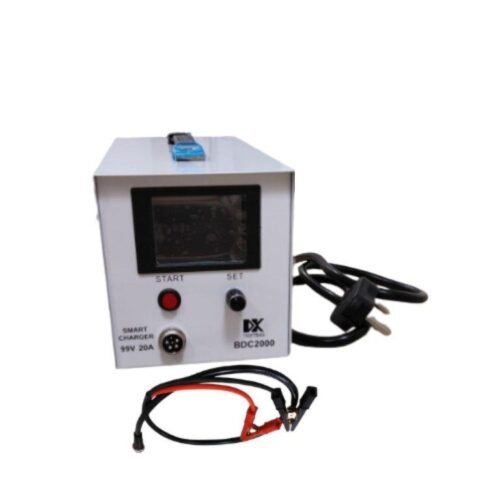
Testing should use equipment rated for the battery’s voltage and current, with appropriate protection and controlled charge/discharge conditions.
Why Choose Lion Battery for Testing in Umargam?
Lion Battery | E-Bike, Solar & UPS Lithium Battery Manufacturer provides battery manufacturing and testing services from Umargam, Valsad, Gujarat.
Lion Battery’s published capabilities include:
- Lithium battery testing
- Capacity testing
- Internal resistance testing
- Cell voltage testing
- Charge/discharge testing
- BMS testing
- Cell matching
- EV battery testing
- Custom battery manufacturing
- Battery repair
- BMS replacement
- OEM/ODM battery manufacturing
Who Can Use Battery Testing Services?
Testing can be useful for:
- EV owners
- E-bike owners
- Electric scooter users
- Battery manufacturers
- EV dealers
- Battery repair centers
- Solar installers
- UPS/inverter companies
- Drone operators
- OEMs
- Battery distributors
- Industrial equipment manufacturers
- Battery startups
Get Your Lithium Battery Tested in Umargam
For testing, provide:
- Battery voltage
- Battery Ah rating
- Battery chemistry
- Battery application
- Battery configuration, if known
- Existing battery problem
- Charger specification, if relevant
If you do not know the battery specifications, you can provide photographs of the battery label, BMS and connectors for initial evaluation.
Contact Lion Battery
Phone / WhatsApp: +91-9724991737
Email: info@lionbattery.in
Location: Umargam, Valsad, Gujarat, India
Related Battery Guides
Related Products