Battery Cell Matching Service in Umargam
Battery Cell Matching Service in Umargam is useful for lithium-ion, NMC and LiFePO4 battery pack manufacturing, battery repair, rebuilding and custom battery projects.
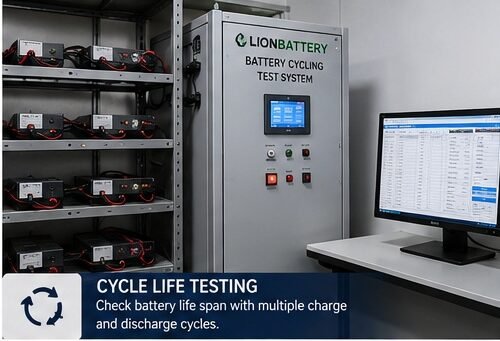
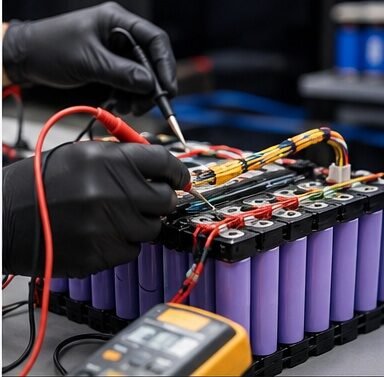
Before assembling cells into a series-parallel battery pack, cells can be tested and compared for voltage, internal resistance, capacity and overall condition. Lion Battery’s published battery manufacturing process includes cell selection, testing and matching before pack assembly.
1. What Is Battery Cell Matching?
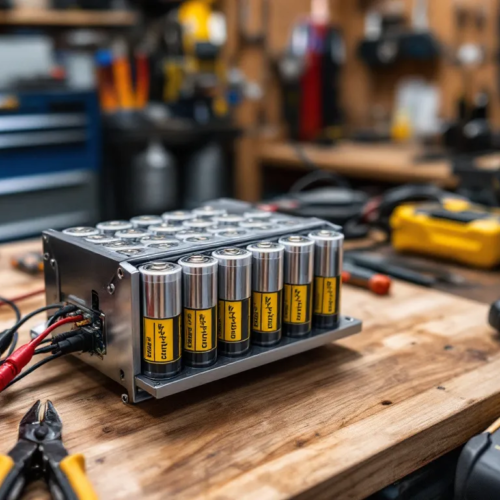
Battery cell matching is the process of testing, grading and selecting cells with similar electrical characteristics before they are assembled into a battery pack.
Cell matching can help create more consistent series and parallel groups and can be particularly important for larger battery packs.
Typical parameters include:
- Open-circuit voltage (OCV)
- Capacity in Ah
- Internal resistance (IR)
- Charge performance
- Discharge performance
- Physical condition
- Cell model and chemistry
- Self-discharge, where required
2. Battery Cell Matching Service in Umargam
Lion Battery provides battery manufacturing and testing solutions from Umargam, Valsad, Gujarat, including cell selection, cell testing and cell matching as part of custom battery pack development.
The service can be considered for:
- New lithium battery cells
- Battery pack manufacturing
- EV battery packs
- E-bike batteries
- Electric scooter batteries
- Solar battery packs
- LiFePO4 battery packs
- NMC battery packs
- Battery repair and rebuild
- Custom OEM battery packs
- Industrial battery applications
3. Which Battery Cells Can Be Matched?
Depending on the project and testing requirements, cell matching can be performed for applications using:
18650 Cells
Commonly used in:
- E-bike batteries
- Portable equipment
- Power tools
- Electronics
- Custom battery packs
21700 Cells
Used in applications requiring higher capacity or current capability, including:
- EV batteries
- E-bike batteries
- Industrial packs
- High-capacity battery packs
LiFePO4 Cells
Used in:
- Solar storage
- ESS
- UPS
- Inverter batteries
- Industrial backup systems
NMC Lithium-Ion Cells
Used in:
- EVs
- E-bikes
- Drones
- Portable power
- Industrial equipment
4. Battery Cell Matching Testing Process
Our typical cell matching workflow can include:
Cell Receiving → Visual Inspection → Cell Identification → Voltage Testing → IR Testing → Capacity Testing → Data Recording → Cell Grading → Matching → Battery Pack Assembly
Lion Battery’s published manufacturing process similarly places cell selection and testing/matching before pack assembly, followed by BMS installation and charge/discharge testing.
5. Cell Voltage Testing
The first step is generally checking the cell voltage.
Voltage readings should be compared under similar testing conditions because cell voltage can vary with:
- State of charge
- Temperature
- Rest time
- Cell chemistry
Cells with unusual voltage readings may require additional inspection before being used.
6. Internal Resistance Testing
Internal Resistance (IR) is an important parameter for comparing battery cells.
Cells with significantly different resistance characteristics can behave differently under load.
IR testing can help identify:
- High-resistance cells
- Abnormal cells
- Inconsistent cells
- Cells requiring further testing
However, IR should not be used as the only criterion for cell selection.
7. Battery Capacity Testing
Capacity testing determines how much energy a cell can actually deliver under specified test conditions.
For example, a cell labelled 5000mAh should not automatically be assumed to deliver exactly 5000mAh in every application.
A controlled capacity test can record:
- Charging voltage
- Charging current
- Discharge current
- Discharge cut-off voltage
- Discharge time
- Actual Ah
- Actual Wh
- Temperature
Capacity testing is particularly useful when selecting cells for custom battery packs.
8. Cell Grading
After testing, cells can be classified according to the project’s acceptance criteria.
Example:
| Parameter | Cell A | Cell B | Cell C |
|---|---|---|---|
| OCV | 3.72V | 3.71V | 3.72V |
| Capacity | 4.98Ah | 5.01Ah | 4.96Ah |
| IR | Recorded | Recorded | Recorded |
| Physical Condition | Good | Good | Good |
| Grade | Suitable | Suitable | Suitable |
Note: Actual acceptable tolerances should be established according to the specific cell model, manufacturer specifications and battery application. There is no single matching tolerance that is appropriate for every battery.
9. Matching Cells for Series Packs
In a series battery pack, cells or parallel groups are connected in series to increase voltage.
For example:
13S Battery Pack
- 13 series groups
- Approximately 48V-class lithium-ion battery
- Each series group should have appropriate consistency
If one group has substantially different capacity or electrical characteristics, it can affect the usable performance of the entire pack.
10. Matching Cells for Parallel Groups
Parallel cells increase battery capacity.
Example:
10P Group
If each cell is 5Ah:
5Ah × 10 = 50Ah
When creating parallel groups, cells should be appropriately selected and brought to suitable voltage conditions before connection.
11. Cell Matching for EV Batteries
For EV and e-bike battery manufacturing, cell matching can be particularly important because the battery may experience:
- High discharge current
- Repeated charging/discharging
- Vibration
- Temperature changes
- Frequent acceleration
- Long operating cycles
Lion Battery’s EV battery manufacturing process includes cell matching and testing, BMS selection, pack assembly and final testing.
12. Cell Matching for Solar & LiFePO4 Batteries
Cell matching can also be used for:
- Solar energy storage
- ESS
- UPS
- Inverter batteries
- Industrial backup
- Telecom batteries
Lion Battery manufactures custom LiFePO4 packs for solar, ESS, UPS, inverter and industrial applications.
13. Cell Matching for Battery Repair & Rebuild
When rebuilding an old lithium battery pack, simply replacing one failed cell may not always be sufficient.
Depending on the battery condition, the remaining cells may need to be evaluated for:
- Capacity
- Internal resistance
- Voltage
- Physical condition
- Self-discharge
This helps determine whether cells are suitable for continued use.
For safety, damaged, swollen, leaking or otherwise compromised cells should not be reused.
14. Cell Matching vs BMS Balancing
These are two different processes.
Cell Matching
Performed during cell selection and battery manufacturing.
Testing → Grading → Matching → Pack Assembly
BMS Balancing
Performed by a suitable BMS after the battery pack is assembled to manage differences between series cell groups.
A BMS is important, but it does not replace appropriate cell selection and matching. Lion Battery’s BMS guidance also treats cell configuration, capacity/current calculation and BMS selection as connected parts of complete battery design.
15. New Cell Matching
For new cells, useful information includes:
- Manufacturer
- Cell model
- Chemistry
- Rated capacity
- Nominal voltage
- Production/batch information
- OCV
- Internal resistance
- Actual capacity
Using compatible cells from the same model and suitable production batches can make pack design and testing more consistent.
16. Used Cell Matching
Used cells require additional inspection before reuse.
Testing may include:
- Visual inspection
- OCV
- Internal resistance
- Capacity
- Self-discharge
- Charge/discharge behavior
- Temperature behavior
A used cell should not be selected only because its voltage appears normal.
17. Battery Cell Matching Report
For professional projects, test data can be recorded for each cell.
A report may contain:
| Test Parameter | Recorded Data |
|---|---|
| Cell Number | Individual ID |
| Cell Model | Manufacturer/model |
| Chemistry | NMC / LFP |
| OCV | Voltage |
| Internal Resistance | mΩ |
| Capacity | Ah |
| Energy | Wh |
| Test Temperature | °C |
| Grade | Accepted / Review / Reject |
| Remarks | Test observation |
This type of record can make it easier to identify and group cells before pack assembly.
18. Why Choose Battery Cell Matching in Umargam?
Lion Battery’s Umargam manufacturing operation supports:
- Cell Selection
- Cell Testing
- Cell Matching
- Custom Battery Pack Design
- BMS Integration
- Battery Pack Assembly
- Charge/Discharge Testing
- Final Quality Inspection
- OEM/ODM Battery Manufacturing
These services are part of the company’s published custom battery manufacturing workflow.
19. Applications
Battery cell matching can be useful for:
- E-bike batteries
- Electric scooter batteries
- EV batteries
- Solar batteries
- LiFePO4 batteries
- UPS batteries
- Inverter batteries
- Drone batteries
- Robotics batteries
- Industrial batteries
- Portable power packs
- Custom lithium battery packs
- Battery repair and rebuilding
20. What Information Should You Send?
For a cell matching enquiry, send:
- Cell type: 18650 / 21700 / prismatic
- Chemistry: NMC / LiFePO4
- Cell model: if available
- Cell quantity
- Rated capacity
- Battery application
- Required battery configuration
- New or used cells
- Required testing parameters
- Photos of the cells, if available
If you are developing a complete battery pack, you can also provide the required voltage, Ah, current, dimensions, application and quantity. Lion Battery uses these requirements when evaluating custom battery pack designs.
21. Contact Lion Battery for Cell Matching Service
Lion Battery – Battery Cell Matching & Testing
📞 Phone / WhatsApp: +91-9724991737
📧 Email: info@lionbattery.in
🌐 Website: Lion Battery
Related Battery Guides
Related Products