Lithium Battery Testing in Umargam, Gujarat
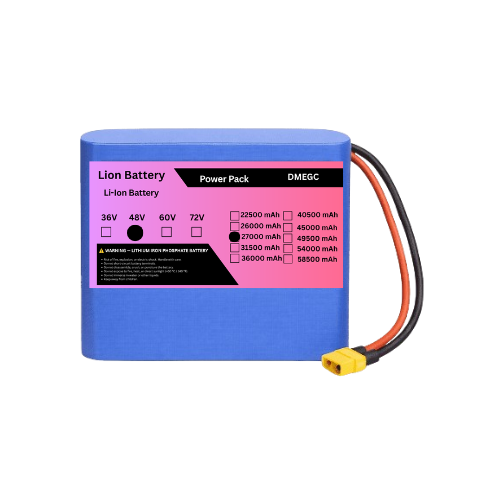
Lion Battery provides Lithium Battery Testing Services in Umargam, Valsad, Gujarat for lithium-ion, NMC, LiFePO4, EV, e-bike, electric scooter, solar, UPS, drone and industrial battery packs.
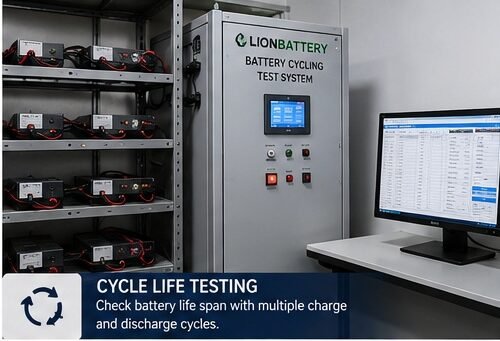
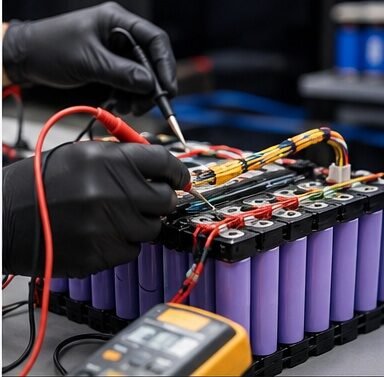
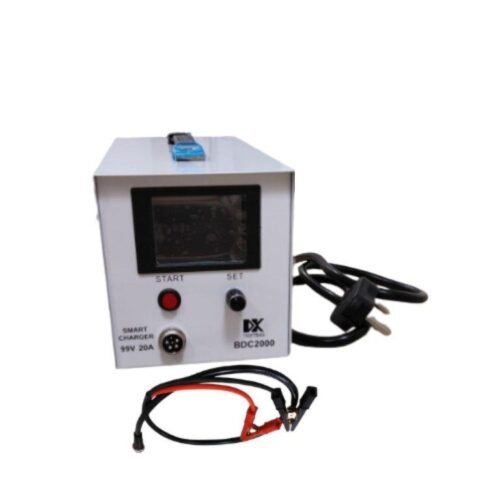
Battery testing helps determine actual battery capacity, cell condition, internal resistance, charging/discharging performance and BMS operation. Lion Battery’s published testing process includes cell voltage, pack voltage, internal resistance, capacity, charge/discharge, cell balancing, BMS, temperature and communication checks.
Lithium Battery Testing Services
Our battery testing can include:
- Battery voltage testing
- Cell-group voltage testing
- Battery capacity testing
- Ah and Wh measurement
- Internal resistance testing
- Charge testing
- Discharge testing
- BMS testing
- Cell balancing check
- Temperature monitoring
- BMS communication testing
- Final battery performance testing
Why Is Lithium Battery Testing Important?
A lithium battery can show normal voltage but still have low capacity or weak cell groups.
Testing can help identify:
- Reduced battery capacity
- Weak cell groups
- Cell imbalance
- High internal resistance
- BMS faults
- Charging problems
- Excessive voltage drop
- Poor discharge performance
- Battery aging
- Wiring or connector problems
For battery repair and refurbishment, testing helps determine whether the problem is with the cells, BMS, charger, wiring or complete battery pack.
Battery Capacity Testing
Capacity testing measures how much energy the battery can actually deliver.
The battery is fully charged and then discharged under controlled conditions using a suitable battery tester/electronic load.
Basic Formula
Capacity (Ah) = Discharge Current × Discharge Time
Example:
A 20Ah battery is discharged at 10A and delivers 19Ah.
Capacity = 19Ah
Capacity percentage = 19 ÷ 20 × 100 = 95%
Capacity testing is particularly useful for:
- Used lithium batteries
- EV batteries
- E-bike batteries
- Battery repair
- Battery refurbishment
- New battery quality checking
- Production quality control
Internal Resistance Testing
Internal resistance testing helps identify cells or cell groups that may have deteriorated.
A battery with unusually high internal resistance may experience:
- Higher voltage drop under load
- Reduced usable capacity
- Increased heating
- Poor high-current performance
- Reduced EV range
Internal resistance should be evaluated against the cell model, test method and operating condition rather than using one universal resistance value.
Cell Voltage Testing
For a multi-cell battery pack, individual series groups can be checked.
For example, a 13S battery can be evaluated by checking:
Cell Group 1 → Cell Group 2 → Cell Group 3 → … → Cell Group 13
Large differences between cell groups can indicate:
- Imbalance
- Weak cell group
- Cell degradation
- BMS balancing issue
- Connection problem
Cell-group voltage testing is part of Lion Battery’s published lithium battery testing process.
BMS Testing
The Battery Management System (BMS) is tested to determine whether the battery’s protection and monitoring functions are operating correctly.
Depending on the BMS, testing can include:
- Overcharge protection
- Over-discharge protection
- Overcurrent protection
- Short-circuit protection
- Temperature protection
- Cell voltage monitoring
- Balancing
- Charging output
- Discharge output
- Bluetooth communication
- CAN communication
- RS485 communication
Lion Battery supports battery packs using standard and smart BMS configurations, including Bluetooth, CAN and RS485 options depending on the application.
Lithium Battery Charge & Discharge Testing
Controlled charge and discharge testing can help verify the actual performance of a battery pack.
Testing Sequence
Visual Inspection
↓
Battery Identification
↓
Pack Voltage Test
↓
Cell-Group Voltage Test
↓
Internal Resistance Test
↓
Controlled Charge Test
↓
Controlled Discharge Test
↓
Capacity / Wh Measurement
↓
Temperature Monitoring
↓
BMS & Communication Test
↓
Final Test Report
This testing sequence is also reflected in Lion Battery’s published battery-testing workflow.
EV Battery Testing in Umargam
Lithium battery testing is important for:
- Electric scooters
- E-bikes
- Electric motorcycles
- Electric three-wheelers
- Custom EVs
- EV battery repair
- Used EV batteries
Testing can help diagnose complaints such as:
“Battery range has reduced.”
“Battery is not charging.”
“Battery voltage drops quickly.”
“Battery shuts down under load.”
“BMS is showing a fault.”
The battery can be tested before deciding whether it needs BMS replacement, cell replacement, balancing or complete battery replacement.
Solar & LiFePO4 Battery Testing
Battery testing is also useful for:
- Solar storage batteries
- Inverter batteries
- UPS batteries
- Home energy storage
- 12.8V LiFePO4 batteries
- 25.6V LiFePO4 batteries
- 48V/51.2V LiFePO4 batteries
- Industrial backup batteries
For solar and ESS batteries, capacity, charge/discharge performance and BMS operation are particularly important because battery performance directly affects backup time.
Drone Battery Testing
Drone batteries need careful testing because high-current applications can place significant demands on cells.
Testing can include:
| Test | Purpose |
|---|---|
| Voltage | Verify pack voltage |
| Capacity | Measure usable capacity |
| Internal Resistance | Evaluate cell performance |
| Discharge | Check current capability |
| Charge | Verify charging |
| Temperature | Monitor heat |
| BMS | Verify protection |
| Communication | Check smart-battery communication |
These are also among the battery tests listed for Lion Battery’s custom agricultural drone battery solutions.
Battery Testing for Manufacturers & OEMs
Battery manufacturers and OEMs can use testing for:
- Prototype validation
- Incoming cell inspection
- Production quality control
- Sample testing
- Battery pack validation
- Capacity verification
- BMS verification
- Final inspection
- Customer quality reports
Lion Battery’s manufacturing process includes cell testing and matching, battery assembly, BMS installation, charging/discharge testing and final quality inspection.
Lithium Battery Test Report
A professional battery test report can include:
| Parameter | Example |
|---|---|
| Battery Model | Custom |
| Chemistry | NMC / LFP |
| Configuration | 13S6P |
| Rated Voltage | 48V class |
| Rated Capacity | 30Ah |
| Initial Voltage | Recorded |
| Measured Capacity | Recorded |
| Internal Resistance | Recorded |
| Cell-Group Difference | Recorded |
| Maximum Temperature | Recorded |
| BMS Status | Pass / Review |
| Communication | Pass / N/A |
| Final Result | Pass / Review |
Recording these results provides useful documentation for manufacturing, repair, refurbishment and quality control.
Lithium Battery Testing Process in Umargam
Lion Battery is a battery manufacturer located in Umargam, Valsad, Gujarat, with published capabilities covering battery testing, custom battery manufacturing, BMS integration and cell matching.
Lion Battery | E-Bike, Solar & UPS Lithium Battery Manufacturer
Battery manufacturer•OpenWebsite
•Directions
Who Can Use Battery Testing Services?
- EV manufacturers
- E-bike manufacturers
- Electric scooter businesses
- Battery dealers
- Battery repair shops
- Solar companies
- UPS companies
- Drone manufacturers
- Industrial equipment manufacturers
- OEMs
- Battery startups
- Individual battery owners
Why Choose Lion Battery for Lithium Battery Testing?
- Battery testing in Umargam
- Capacity testing
- Internal resistance testing
- Cell voltage testing
- BMS testing
- Charge/discharge testing
- Li-ion testing
- NMC testing
- LiFePO4 testing
- EV battery testing
- Solar battery testing
- Custom battery manufacturing
- Battery repair and refurbishment support
Contact Lion Battery
For Lithium Battery Testing, Battery Capacity Testing, BMS Testing, EV Battery Testing, Battery Repair and Custom Battery Manufacturing, contact Lion Battery.
Phone / WhatsApp: +91-9724991737
Email: info@lionbattery.in
Location: Umargam, Valsad, Gujarat
Related Battery Guides
Related Products