Battery Testing Services
Battery Testing Services
Battery Testing Services | Lithium Battery Cell & Pack Testing
Lion Battery provides professional Battery Testing Services for lithium-ion, NMC, LiFePO₄ (LFP), 18650, 21700, prismatic cells, and complete battery packs.
Our battery testing services help businesses, manufacturers, EV companies, battery repair professionals, and product developers evaluate battery capacity, voltage, internal resistance, cell balance, charging performance, discharge performance, and BMS operation.
To visit Click Here
Our Battery Testing Services
| Testing Service | Purpose |
|---|---|
| Battery Voltage Testing | Check battery voltage |
| Cell Voltage Testing | Identify cell voltage differences |
| Capacity Testing | Measure actual Ah capacity |
| Energy Testing | Measure Wh / kWh output |
| Internal Resistance Testing | Evaluate cell condition |
| Charge Testing | Check charging performance |
| Discharge Testing | Evaluate battery output |
| Cell Balance Testing | Identify cell imbalance |
| BMS Testing | Check BMS functions |
| Battery Pack Testing | Evaluate complete battery pack |
| Cell Matching Testing | Compare cells for pack assembly |
| Used Battery Testing | Evaluate aged batteries |
What Is Battery Testing?
Battery testing is the process of measuring the electrical and functional characteristics of a battery or individual cell.
Testing can help determine whether a battery is:
- New and performing as expected
- Suitable for battery pack assembly
- Degraded
- Unbalanced
- Suitable for refurbishment
- Experiencing reduced capacity
- Showing abnormal internal resistance
- Operating correctly with its BMS
1. Battery Capacity Testing
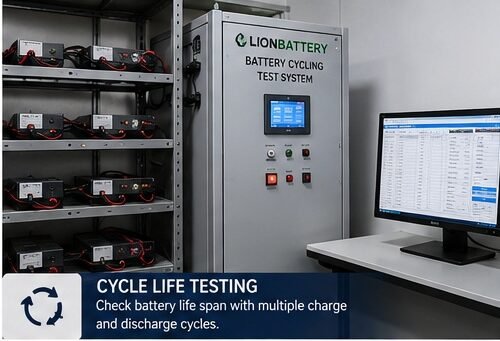
Capacity testing measures the actual amount of charge a battery can deliver under defined test conditions.
Capacity is generally expressed in:
- Ah (Ampere-hours)
- mAh (Milliampere-hours)
For example, a battery marked 20Ah may not deliver exactly 20Ah under every operating condition. Actual capacity depends on the test current, temperature, cutoff voltage, cell characteristics, and test method.
Capacity testing is useful for:
- New battery quality control
- Used battery evaluation
- Battery refurbishment
- Cell matching
- Battery pack manufacturing
- Warranty evaluation
2. Internal Resistance Testing
Internal resistance testing helps identify differences between cells and can provide useful information about battery condition.
A cell with significantly higher internal resistance than comparable cells may exhibit:
- Greater voltage drop under load
- Increased heat generation
- Reduced power capability
- Poorer performance
Internal resistance measurements should be interpreted together with other test results rather than used alone to determine battery health.
3. Cell Voltage Testing
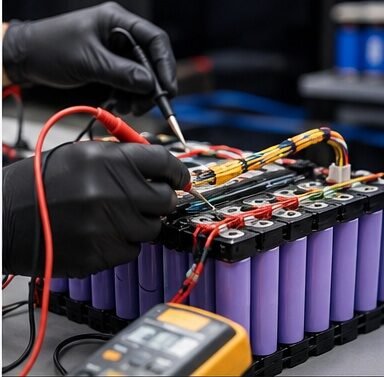
Individual cell or cell-group voltages can be measured to identify:
- Voltage imbalance
- Weak cell groups
- Abnormal voltage
- Charging problems
- Possible BMS-related issues
Cell voltage testing is particularly important for multi-series lithium battery packs.
4. Battery Discharge Testing
Discharge testing evaluates how a battery performs under a defined load.
Testing can measure:
- Discharge capacity
- Voltage behavior
- Runtime
- Voltage drop
- Cutoff behavior
- Temperature response
Discharge testing can be performed according to the requirements of the battery and application.
5. Battery Charging Testing
Charging tests can be used to evaluate:
- Charging voltage
- Charging current
- Charging time
- BMS charging protection
- Cell voltage behavior
- Cell balancing
The charger must be appropriate for the battery chemistry and series configuration.
6. Cell Matching Testing
Before assembling a battery pack, cells can be tested and compared for:
- Capacity
- Internal resistance
- Voltage
- Chemistry
- Physical condition
Cells with compatible characteristics can then be grouped for battery pack assembly.
Learn more about our Cell Matching Service.
7. BMS Testing
Battery Management System testing may include checking:
- Cell Voltage Monitoring
- Pack Voltage
- Current Measurement
- Temperature Sensors
- Cell Balancing
- Overcharge Protection
- Over-Discharge Protection
- Overcurrent Protection
- Short-Circuit Protection
- Communication
For Smart BMS systems, communication interfaces such as CAN, RS485, UART, or Bluetooth may also be evaluated where applicable.
8. Battery Pack Testing
Complete battery packs can be evaluated for:
- Pack Voltage
- Capacity
- Energy
- Discharge Performance
- Charging Performance
- Cell Balance
- BMS Operation
- Temperature
- Connector & Wiring Condition
This is useful for both newly manufactured and refurbished battery packs.
Battery Testing for Different Battery Types
Lithium-ion / NMC Battery Testing
Suitable for:
- 18650 Packs
- 21700 Packs
- E-Bike Batteries
- EV Batteries
- Drone Batteries
- Robotics Batteries
- Portable Power Packs
LiFePO₄ Battery Testing
Suitable for:
- Solar Batteries
- ESS Batteries
- UPS Batteries
- Inverter Batteries
- EV Batteries
- Industrial Battery Packs
Battery Testing for Different Applications
EV Battery Testing
We can test suitable EV battery packs for:
- Capacity
- Voltage
- Cell Balance
- Internal Resistance
- BMS Function
- Charge / Discharge Performance
E-Bike Battery Testing
Testing can help identify:
- Reduced range
- Weak cell groups
- BMS problems
- Reduced capacity
- Charging issues
Drone Battery Testing
Testing can evaluate battery capacity, voltage behavior, internal resistance, and discharge performance according to the application requirements.
Solar & ESS Battery Testing
Testing can help evaluate LiFePO₄ battery packs for energy-storage applications.
Industrial Battery Testing
Suitable for batteries used in:
- Robotics
- AGV / AMR
- Telecom
- Backup Power
- Industrial Equipment
- Portable Power
Battery Testing Process
Step 1 – Visual Inspection
The battery or cell is inspected for:
- Physical damage
- Swelling
- Leakage
- Corrosion
- Damaged terminals
- Wiring problems
Step 2 – Voltage Measurement
The initial voltage is measured and recorded.
Step 3 – Internal Resistance Test
Internal resistance is measured where appropriate.
Step 4 – Capacity Test
The battery can undergo controlled charge/discharge testing to determine its measured capacity.
Step 5 – BMS Testing
The BMS and protection functions are evaluated where applicable.
Step 6 – Test Data Analysis
Results are compared with the relevant battery specifications and test criteria.
Step 7 – Test Report
For applicable projects, test results can be documented for quality control, manufacturing, repair, or evaluation.
Battery Testing Report
A battery testing report can include:
| Parameter | Test Result |
|---|---|
| Battery Model | Recorded |
| Chemistry | NMC / LFP |
| Nominal Voltage | Specification |
| Measured Voltage | Test Result |
| Rated Capacity | Specification |
| Measured Capacity | Test Result |
| Internal Resistance | Test Result |
| Charge Test | Result |
| Discharge Test | Result |
| Cell Balance | Result |
| BMS Status | Result |
| Temperature | Test Result |
Why Battery Testing Is Important
Professional testing can help:
- Identify Weak Cells
- Determine Actual Battery Capacity
- Detect Cell Imbalance
- Identify Abnormal Internal Resistance
- Verify Battery Performance
- Support Battery Refurbishment
- Improve Battery Pack Quality Control
- Assist Cell Matching
- Verify Newly Manufactured Packs
Battery Testing for New & Used Batteries
New Battery Testing
Useful for manufacturers and businesses to verify battery packs before delivery.
Used Battery Testing
Testing can help determine whether an existing battery may be suitable for continued use, refurbishment, or replacement.
Refurbished Battery Testing
After cell replacement or BMS repair, testing can verify the battery’s performance under defined conditions.
Why Choose Lion Battery?
- Lithium Battery Testing
- NMC Battery Testing
- LiFePO₄ Battery Testing
- 18650 & 21700 Cell Testing
- Capacity Testing
- Internal Resistance Testing
- Charge & Discharge Testing
- Cell Matching
- BMS Testing
- Battery Pack Testing
- Battery Refurbishment Support
- Custom Battery Manufacturing
Important Safety Information
Lithium battery testing should be performed using equipment and procedures appropriate for the battery’s voltage, current, chemistry, and energy level.
Do not test swollen, leaking, burnt, severely damaged, or otherwise unsafe lithium batteries without appropriate professional assessment and safety controls.
Frequently Asked Questions
What is battery testing?
Battery testing measures the electrical and functional performance of a battery or cell, including parameters such as capacity, voltage, internal resistance, charging, and discharge performance.
Can you test lithium-ion batteries?
Yes. We provide testing services for suitable NMC, lithium-ion, 18650, 21700, and other lithium battery cells and packs.
Can you test LiFePO₄ batteries?
Yes. LiFePO₄ cells and complete battery packs can be tested for capacity, voltage, internal resistance, cell balance, and other applicable parameters.
Can you test an old battery?
Yes. Used battery testing can help determine its measured capacity and condition. The battery must first pass a safety and physical inspection.
Can battery testing identify a weak cell?
Testing can help identify cells or cell groups that differ significantly in voltage, capacity, or internal resistance.
Do you provide battery test reports?
Test results can be documented for applicable battery testing, manufacturing, cell matching, repair, and quality-control projects.
Contact Lion Battery
Lion Battery
📞 Phone / WhatsApp: +91-9724991737
📧 Email: info@lionbattery.in
🌐 Website: lionbattery.in
Related Battery Guides
Related Products